
Franciscans of the Eucharist of Chicago - Men's Community
Contact
Bishop Bob Lombardo C.F.R.
Guardian & Vocation Director for the Men's Community
3808 W. Iowa St.
Chicago, IL 60651-3708
vocations@fechicago.org
www.fechicago.org
Dioceses
Archdiocese of Chicago
Mission
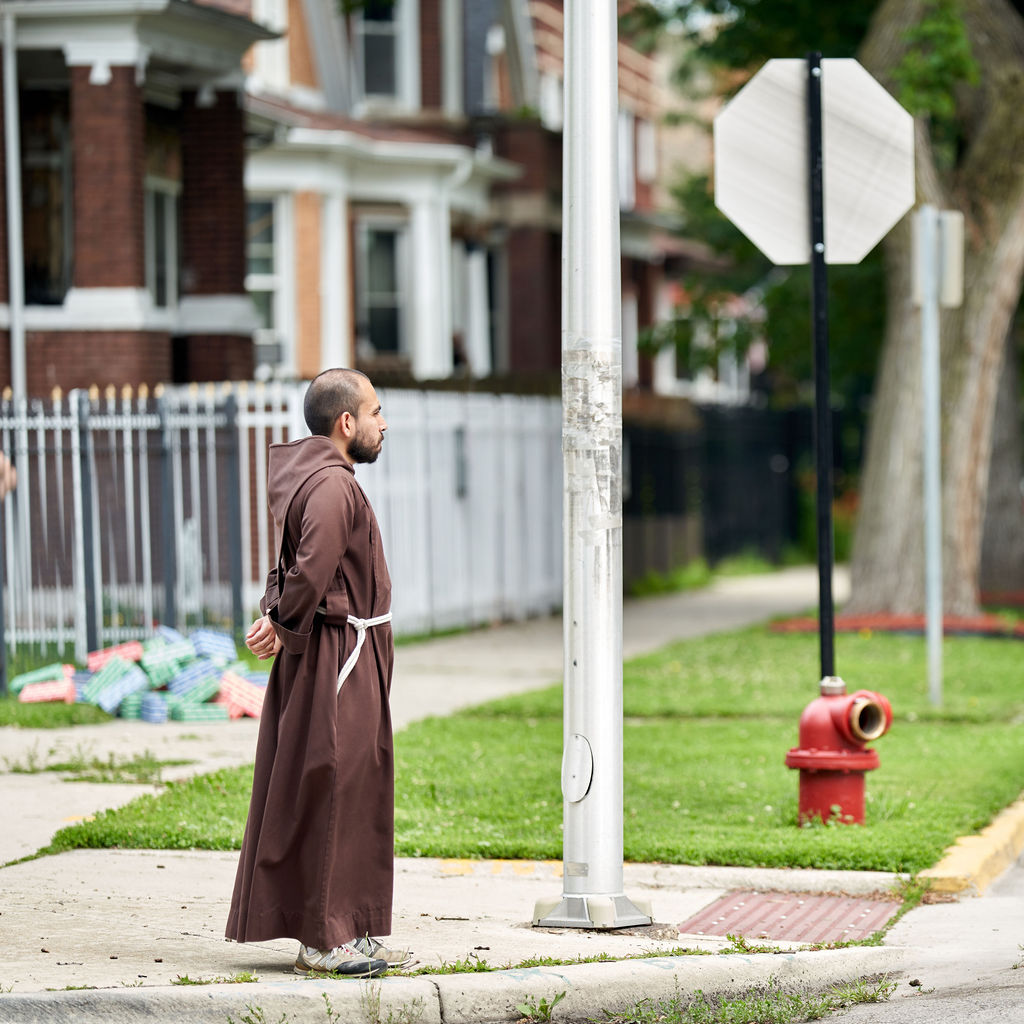
The Franciscans of the Eucharist of Chicago are a Catholic Franciscan religious community living and serving among the poor in Chicago’s West Humboldt Park neighborhood with branches for men and women. Our life centers upon our relationship with Jesus Christ in the Eucharist. Our life of prayer flows into our community life and our apostolates: service to the poor and evangelization through preaching and teaching. In our apostolates we emphasize providing opportunities for encounters with Jesus in the Eucharist both at Mass and in Eucharistic Adoration. We believe that if you can’t see Jesus in the Eucharist, you can’t see Him in the poor.
The roots of our community began in 2005 when Father (now Bishop) Bob Lombardo, CFR came to Chicago at the invitation of Francis Cardinal George to open a mission to serve the poor and maintain a Catholic presence in one of Chicago’s poorest neighborhoods. The site chosen was Our Lady of the Angels, known for the tragic school fire which claimed the lives of 92 children and three Sisters of Charity of the Blessed Virgin Mary on December 1, 1958. Since the fire, the neighborhood surrounding the parish had rapidly declined. When Fr. Bob arrived in 2005 it was one of the most desperate, needy neighborhoods in Chicago. The Cardinal wanted Fr. Bob to establish a mission at the former Our Lady of the Angels parish not only because of the history and the need, but also to let the neighborhood know that the Church had not forgotten the poor. Fr. Bob got to work on renovating the dilapidated parish buildings and the Mission of Our Lady of the Angels was officially founded to serve the needs of the neighborhood and pass on the treasures of our Catholic faith.
When Fr. Bob began the Mission, many young adults were attracted to come serve at Our Lady of the Angels. Among these young people were men and women interested in religious life who desired simplicity and prayer, serving the poor and spreading the message of the Gospel. Fr. Bob encouraged them to visit other communities which carried out these works, but some of them were still attracted back to Our Lady of the Angels, and Fr. Bob began to discern that the Lord was raising up a new branch of the Franciscan family at Our Lady of the Angels.
In August 2009, at the request of Fr. Bob, Cardinal George approved a live-in discernment community. Under Fr. Bob’s direction, this community flourished, and it became clear that the Lord was inspiring a new Franciscan community in Chicago to serve the poor, carry out the work of evangelization and teaching, and live a life centered on the Real Presence of Jesus Christ in the Eucharist. From the beginning, the community was founded to have branches for both men and women, with a strong commitment to the friars and sisters working together in order to witness to the complementarity of men and women (inspired by St. John Paul II’s Theology of the Body).
The Franciscans of the Eucharist of Chicago were canonically established with a decree by Cardinal George on September 1, 2010, with Fr. Bob Lombardo as the Founder and Guardian (Superior). On September 11, 2020, Fr. Bob was elevated to the Episcopacy by Pope Francis. Bishop Bob continues to serve as the Guardian of the Franciscans of the Eucharist of Chicago in addition to his responsibilities as an Auxiliary Bishop of Chicago.
The community has continued to grow in numbers over the years, and our outreaches to serve the poor and preach and teach the Gospel, which are at the heart of our charism, have been very blessed. Every month, over 3,000 families are assisted with food and other basic needs, hundreds of youth and seniors are supported through programs to help them flourish, including after school programs, pop-up medical clinics, and senior citizen groups. The Faith is proclaimed to thousands of Catholics throughout the Chicagoland area and beyond through Parish Missions, Confirmation retreats, parish talks, retreats, school visits, and teaching religion in poor Catholic schools. As the community grows, our apostolate will grow to build up to perpetual Eucharistic Adoration and teaching religion in more poor Catholic schools and parishes.
Although the women's branch has grown at a faster pace, the men's branch has had a steady presence since the very beginning. Bishop Bob Lombardo serves as our founding member and guardian, and although he has now been asked by the Church to assume the responsibilities of the episcopacy, he fulfills this in a way that still allows for his daily presence in our community, and he remains very active and present as the current our guardian and the director of our main mission center - the Mission of Our Lady of the Angels.
In addition to Bishop Bob, we have had young men in various stages of initial formation throughout the vast majority of our community history. Although the men's branch has been slower to develop, the intention to form parallel branches and bear witness to the complementarity of men and women within the Church remains an essential component of our founding charism, and we have great hope that the Lord will continue to inspire and call young men to join our community. We are grateful to the Lord for His tremendous providence and look forward to all the good things He has in store for our community in the years to come, always keeping our eyes fixed on Jesus Christ, following Him in the footsteps of St. Francis of Assisi.
Qualifications
Completion of college (undergraduate) degree, good physical and mental health, appropriate maturity for the life and apostolate, attraction to St. Francis of Assisi and service to the poor, fidelity to Christ and the Church.
Formation
Bishop Bob is the primary formator for the men’s branch of our community. Formation includes a time of postulancy (6 months - 1 year), novitiate (2 years), and temporary vows (3-5 years), after which a friar may request to profess final vows. Young men in formation receive in-house classes alongside sisters in formation, individual formation meetings with Bishop Bob, and will study at Mundelein Seminary while in temporary vows. A friar who feels called to ordination to the priesthood would study alongside seminarians at Mundelein Seminary and receive the additional formation opportunities that come with that particular track. All members of our community receive a masters degree in theology from Mundelein Seminary, and so a different course of study would be provided for those who do not discern a priestly vocation. Because our community is not founded to do parish work, ordained friars would primarily exercise their priestly ministry offering the sacraments for our community and events with neighbors and benefactors/volunteers, retreats, parish missions, and itinerant preaching. Friars who will be serving in the teaching apostolate and who do not already have a teaching license will go on for further studies in education as well. Formation is holistic, working with each new member to help them grow personally, spiritually and communally, step-by-step, taking on the new identity as a consecrated religious brother or sister following Christ in the footsteps of St. Francis. Formation includes the following dimensions: • Spiritual: supports for growth in one’s life of prayer including classes and spiritual direction, learning to set time aside for personal prayer, becoming accustomed to the communal prayer life, introduction to and ongoing fostering of understanding of Franciscan Spirituality and the treasures of the Catholic Faith, especially the Eucharist • Human: including meetings with the formation director and community meetings, learning how to live virtuously with others in community, allowing appropriate time for exercise and personal growth, developing healthy & holy boundaries in the community and beyond • Intellectual: including classes on religious life, Franciscan History and Spirituality, graduate studies in Theology, and graduate studies in education (if needed for the teaching apostolate) • Pastoral: introduction to and integration (over time) into the apostolate of the community, development of identity as a “public person” representing the religious community/the Church, developing healthy & holy boundaries in the apostolate.
Province
Not Applicable